Wednesday, March 2, 2011

The Forgotten


In the age of childhood obesity their is a group of boys that are invisible. Invisible to football coaches, invisible to the eye of girls, invisible, not because they are gone. But because they are SKINNY and UNDERWEIGHT!

I’m not going to drag this out because it doesn’t need to be too incredibly complicated or over analyzed. But I’m just going to list the things you NEED to do if you want to gain muscle as a skinny kid. Because face it, nobody cares that you've got a 6-pack if you get blown around like a leaf in a light breeze.

  1. Look at what overweight people are doing and do it. Except add in some weight lifting to it.
  2. Speaking of weight lifting, don’t spend all day in the gym. 45 minutes…TOPS!!
  3. Because you’re on a time crunch in the gym, you’d better be doing exercises that use most or all of your muscles. More muscle usage = more testosterone and growth hormone
  4. If you play a high activity sport such as basketball, soccer or swimming, gaining weight will be even TOUGHER. So if you aren’t practicing or lifting weight, you need to be eating. 
  5. SLEEP... a lot.

Today I will just discuss the first point and I will address the others in future blog posts.

Step 1: try to become overweight.

            Granted we don’t want you to be obese and slothful, but we do want you to gain weight. And there is no better person to look at for gaining weight, than somebody who has…gained a lot of weight. What is it they do? Well, they eat a lot. They eat frequently. And they eat a lot of carbohydrates; which is what you need. But you also need to make sure you’re building muscle instead of adding fat to your belly.
            And the thing with most skinny kids is when they think they are eating a lot of food, they usually AREN'T eating enough. Put it this way, if you aren’t gaining weight, you need to eat more. 

Here is what a skinny guy’s day should look like if he works out in the morning

Wake up (0 hours) – eat 1 measured cup of oatmeal (300 calories), 2 cups of milk (244 calories) Total = 544 cal

Workout – have a protein shake (130 calories)

After workout ( + 1.5 hours after wakeup) – 2 pancakes (350 calories), 1 cup cottage cheese (204 calories), ½ cup orange juice (56 calories) Total= 600

Snack ( + 2.5 hours) – 1 bagel (270 calories), 3 tbsp peanut butter (300 calories) Total = 570

Lunch ( + 4.5 hours) – 1 can tuna (150 cal), 2 tbsp mayonnaise (200 cal), ¼” slice of cheese from block (200 cal), 2 slices of bread (140 cal), a salad the size of a boat (60 cal), balsamic dressing (enough, but less than you think)(150 cal) Total = 900 cal

Is this what you see in the mirror??
Snack ( + 7.5 hours) – 2 cups yogurt (200 calories), ¼ cup peanuts (300 cal), ½ cup granola (180 cal) Total = 680 cal

Dinner (+ 10.5 hours) – Meat the size of your hand (300 cal), [broccoli + raisins] the size of your hand (150 cal), glass of milk (200 cal) Total = 650 cal

Before bed meal ( + 12.5 hrs) – 2 Scrambled eggs or protein powder (150 cal) + spoonful of peanut butter (200 cal), apple (75 cal) Total = 425 cal

Total calories = 4500 calories*

For most kids this is going to seem insurmountable. But it can be done. And with a quality lifting program, it can add a significant amount of muscle to ANY kids frame.

Tuesday, February 8, 2011

No plyometrics until you squat THIS much...

The world of exercise science and program design is constantly changing. Not because the ideals, principles and philosophies are wrong, but because we really are beginning to learn so much about the body and how it responds to exercise.

One of the hotter topics is that of plyometrics. Most people "know" what plyometrics is. They may have the textbook definition of "a rapid eccentric muscle action followed by an immediate concentric muscle action resulting in increased power," but they have an image in their head of what plyometrics is. And it usually looks something like the picture to the right.

But there are different levels of plyometrics and the truth is most people begin a plyometric training program at far too high of an intensity. But there really isn't a set standard that a person must meet prior to beginning a plyometric program. 
There used to be a "generally accepted" formula for plyometrics and it was that you had to be able to back squat twice your body weight. However this immediately labeled plyometrics as a VERY exclusive type of training program. After all, how many people can actually back squat twice their body weight? If I were to do that I would have to be able to squat 410 lbs!! 

So where did this formula come from? Well it was grounded in science but wasn't necessarily thought about completely. You see when a person is coming down from the peak of a jump their are accelerating at 9.8 meters per second squared. So until the person hits the ground, they are accelerating, or picking up speed, until they land. And for most people the range of their jump has them hitting the ground at a fairly high rate of speed. So much that research has shown the amount of force a person lands with is equivalent to roughly twice their body weight. This we know is true.

However, it must be considered that A) on a squat jump landing the person usually does not land in a full squat position, and B) not all plyometrics involve such extreme landings. The video below gives some plyometric exercises that we use on a regular basis.
So then what are we to do? Do we simply focus on kids getting better at their back squat so they can FINALLY do plyometrics with them? That is obviously not going to happen. Instead what we at Pair & Marotta Physical Therapy do is have them work through a progression. Obviously not every plyometric involves a depth jump from a great range of motion. 

In addition, the thing to consider is that in sport, most plyometric type of contractions involve vertical jumps. Most require movement in multiple planes of motion.So instead we can and occasionally do have our athletes perform box drop jumps. But most often we use lower level, more laterally stressful plyometric exercises.


As a coach, you too must decide the cost to benefit factor and determine what type of plyometric exercises are going to be best for your athletes. Have a system. Or better yet, give us a call to help design and implement a plyometric training program with your athletes or team!

Wednesday, January 26, 2011

The Core 4

When people ask me about my top core exercise I always have this little debate in my head. As I have stated in previous posts, there really needs to be a progression of exercises. So what I am going to do is give the top exercise in each of the 4 progressions: (1) postural control, (2) stabilization, (3) strength, 4 (power/reactive).

Pelvic Tilting
1. The first exercise that should be done is simply Pelvic Tilts. The reason for this is that many people, in particular youth athletes have are not able to change the position of their hips on command. This is a fundamental skill that ALL athletes should possess. If an athlete is unable to do this, generally every other functional exercise is going to suffer.
To do a pelvic tilt exercise, have the athlete lie on their back with their knees bent. Have them place one hand under their back and simply alternate between lifting their back off their hand and putting pressure down on their hand. Hold each position for 2-5 seconds.


Full Side Plank
2. The second stage of core training is stabilization/endurance. Athletes need to be able to maintain a stable spine for a prolonged period of time. The side plank does just this. It activates obliques, transverse abdominus, multifidus, low back extensors and the rectus abdominus. Its a grand slam of a core exercise.
To do the side plank support yourself on one arm with your feet stacked and hold that posture for between 20-45 seconds


Hand Walkout
3. The best strength exercise is the Hand Walkout. Why? Well it trains the body in the sagittal plan, so it uses the rectus abdominus "six pack" muscle. But it also engages the obliques and transverse abdominus. The hand walkout is an "anti-extension" exercise that uses the postural control and strength of the prior to phases. 

To do the hand walkout, simply start from a push-up position and take small steps forward with your hands, keeping your feet where they are. Walkout until you feel tension in your abdominals and then walk your hands back in.


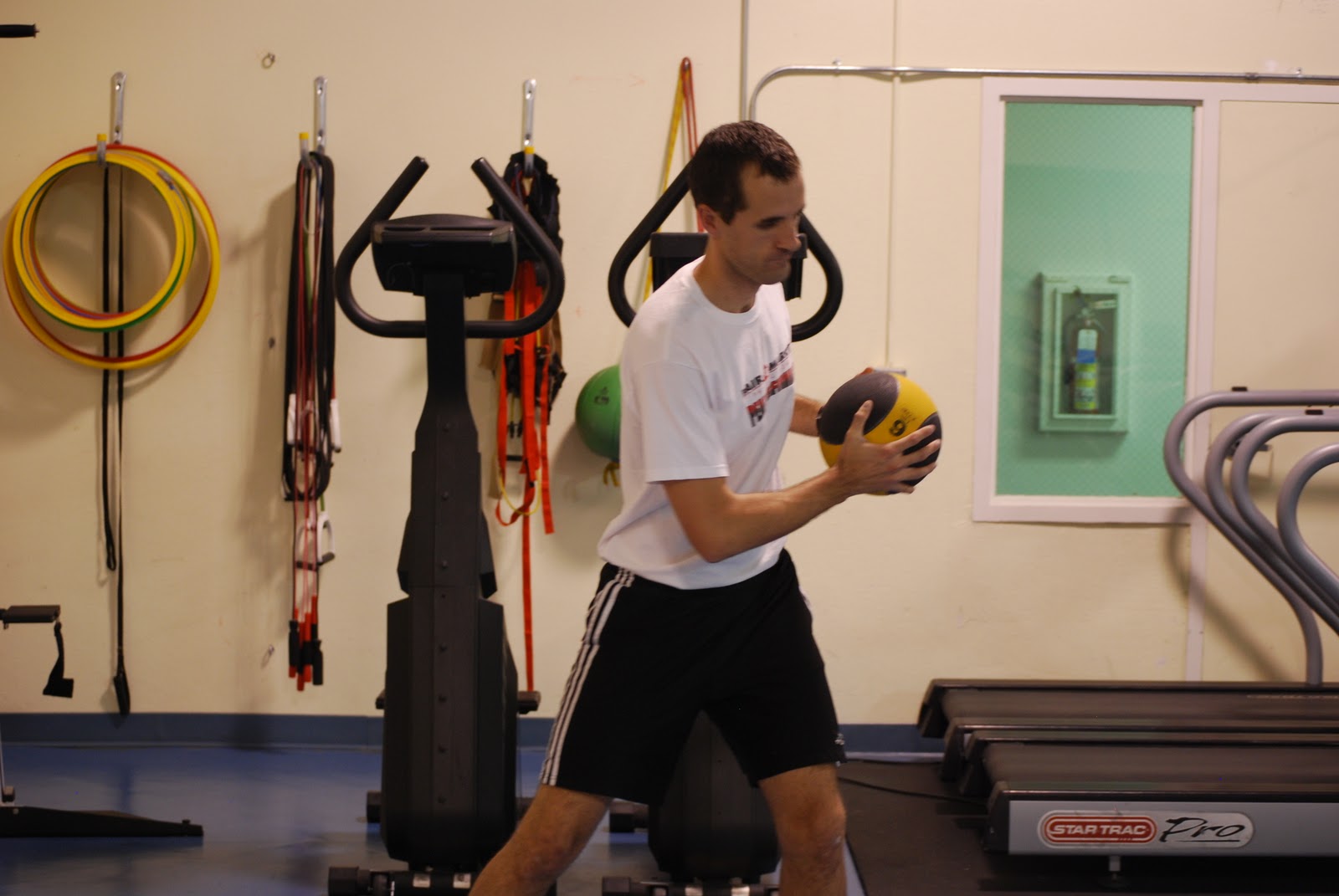
4. The best plyometric/reactive exercise is Medicine Ball Shakers. This exercise requires the spinal stabilization muscles and the hip rotators to contract and relax rapidly. The ability to turn a muscle on and off quickly is crucial for sports performance and everyday living. And because most motion takes place in the rotational/transverse plane, this exercise is our champion. 

Simply hold a medicine ball in front of you and quickly shake it side to side. Don't attempt to use a "full range of motion" because most people will end up over torquing the muscles of the lower back. Instead focus on short rotations that allow the ball to travel a maximum of 12" before you bring the ball back the other way. Perform 10 repetitions as fast as possible - shoot for under 6 seconds.

And there you have it. Our Core Top 4!.

How much core training is REALLY necessary?

Postural endurance is foundational at Pair & Marotta.
Many coaches will ask, how much core training do I really need? Often times its completely dependent upon the moaning and groaning of their team. But at that point, you're letting the team run the practice. And that's just your first worry. 

In addition to that, consistency will lack and so will results. But if you have a plan that is scheduled and gradually progresses the exercises, then you can guarantee that your team is all meeting a minimum level of performance. So once the plan is established all you have to do is keep raising the bar!

So how much is really necessary?

Well Dr. Stuart McGill talks about this in his book, "Ultimate Back Fitness and Performance," he states that the core muscles that stabilize the back are type-I, slow twitch muscles that are meant to make small, adjustments to keep the spine steady instead of making large range of motion adjustments. So core stabilizing muscles should be trained for muscular endurance. And as the coaches who attend our "On-Field Core Training" workshop last weekend saw, there are many ways that we can do this. But think about how the abdominals are used during throwing and swinging a bat. They act like any other muscle does, requiring a strong, fast contraction to allow the larger muscles of the hips and shoulders to pull from. Basically they have to act like an anchor. So those muscles need to be trained to react quickly to a stimulus. 

Think about how the core must contract at the moment that the baseball hits a bat? The core must contract and stiffen the spine to prevent any absorbing of force. If this is done correctly, the batter will be able to transfer up to 90% of his power back into the ball to create a hard hit.

So in prescribing exercises for this type of contraction, you can prescribe it just like you would any other plyometric exercise, intensity of the exercises will play a large role. For our capability of using only body weight, a partner or a bat,  2-3 sets of 8-20 repetitions per exercise is optimal. A good method would be to operate in phases. 
Cable lifting is near the top of the core training pyramid.

 For example phase 1 would be 2 sets of 8. Phase 2 would be 2 sets of 12-15. Phase 3 would be 2 sets of 15-20. Phase 4 would be to add another set and decreasing repetitions. So 3 sets of 10-15 would be optimal and then finally phase 5 would be to have 3 sets of 15-20. But as a coach you CANNOT let form and technique deteriorate. Remember, you play how you practice. This goes with core training too!

Wednesday, January 12, 2011

3 things to save your player's shoulders...

Shoulder injuries are the most common injuries in baseball and softball players. A study in 1999 surveyed 500 youth pitchers and found that over half of them sustained some time of shoulder or elbow pain during the course of the season. The study found that the more pitches thrown correlated with an increase in elbow and shoulder pain. 

On first thought it would seem that we simply need to strengthen the shoulders and elbows of these pitchers. But lets look at things a little deeper and connect the chain and see where it ends up:
Muscles that comprise the Rotator Cuff
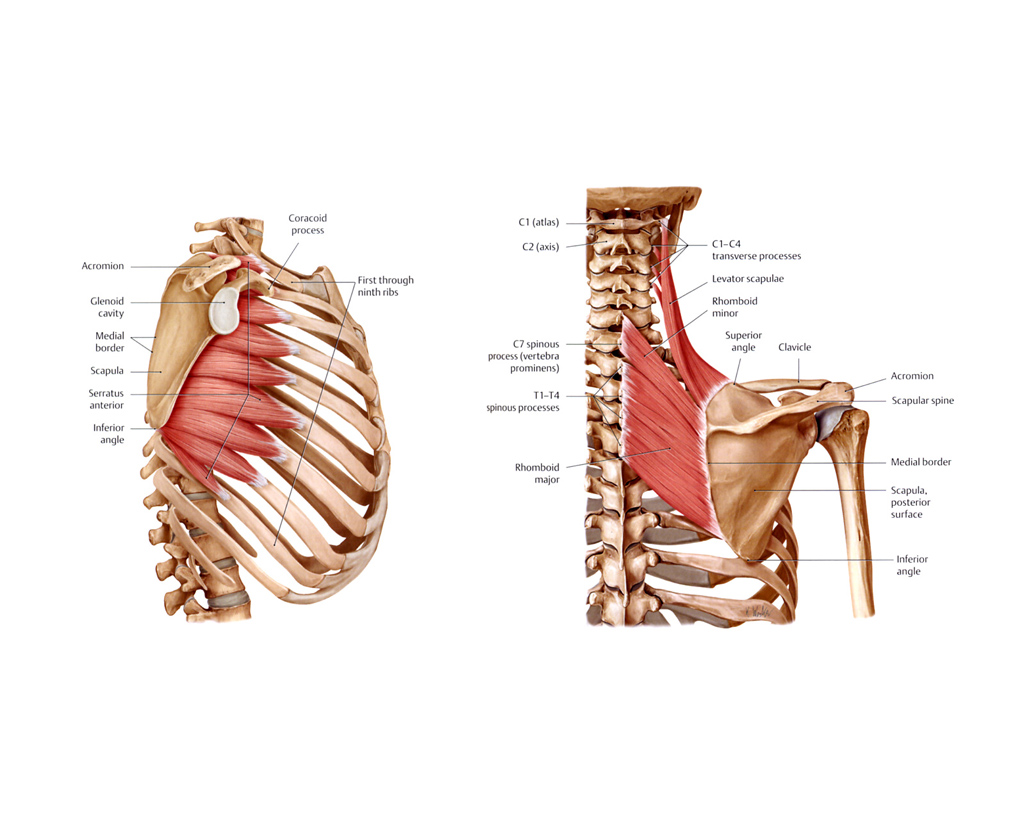
  • The Glenohumeral (shoulder ball and socket) joint has muscles (rotator cuff) that attach it to the scapula
  • Scapula is a "floating bone" which is anchored to the rib cage by the anterior serratus  
  • The scapula to the spine by the rhomboids and the levator scapulae.
  • The spine is stabilized by the core muscles  
If any muscle along that chain is weak, the unit will only function as well as the weakest muscle can tolerate. In other words, the chain is only as strong as its weakest link.
Fortunately, there are many core exercises that can be used to strengthen all of the muscles together as a unit, thereby increasing the ability of the ENTIRE chain.

So here are 3 exercises that you can do to train the kinetic chain of an overhead thrower.

1. Side planks - Side planks train the muscles of the Glenohumeral joint, scapulothoracic joint as well as the lumbar stabilizers in the frontal (lateral) plane. This is one of the best exercises for improving core stability and is a necessity for ANY overhead throwing athlete.
 
2. Supine opposites/ Deadbug - the deadbug trains the muscles of each side of the body to operate independently. This trains the body to prevent rotation and stabilize the core - a REAL strength and control exercise 


Med Ball Shakers

3. Med ball shakers - Using a medicine ball, take an athletic stance and quickly shake the ball back and forth for 6-10 seconds. You'll know if you are doing it correctly because your abdominals will be on fire. If you're arms are burning then there is a good chance that you are having issues using your abs to initiate motion and instead are using your arms.

These arejust three of the exercises that we have used in our the baseball players we train for speed, agility and quickness here at Pair & Marotta Peak Performance!

To learn more about core training for Baseball and Softball using just your body weight and a bat, get registered for our "On-Field Core Training for Baseball/Softball" workshop on Saturday January 22 from 10am-noon. You'll leave with a TON of valuable tools that you can use on field with your team!!
Email aaron@pairmarotta.com for more information!

Friday, January 7, 2011

3 Things you NEED to know about core training...

Often times we read things and get so excited about them that we forget where we are reading them. We forget that Men's Health needs to ultimately sell magazines to stay in business. So they are going to print things that people like.

I used to subscribe to Men's Health. But then I started noticing a lot of similar articles popping up and also a lot of filler and fluff.

In each issue they do have a few well put together articles. Many having to do with grooming, sex and then of course getting ripped in 15 minutes a day. In fact I remember one issue had what was called the "Ripped in the Shower." It consisted of stretching your chest, some body weight squats, calf stretching and some isometrics for the biceps and triceps.

One of the guys that Men's Health looks to for information on back fitness is Dr. Stuart McGill. We at Pair & Marotta Physical Therapy also look to him (and a few others) when we want to see what the newest research in back health is saying.

Dr. McGill has a book out titled "Ultimate Back Fitness and Performance." I've been using the information provided in it with clients and patients for a little over a year now and the results are amazing!

So here are 3 things that we've gotten from "Ultimate Back Fitness and Performance":

  1. You have to control the spine before you can hope to unleash its ability. Too many coaches are busy doing exercises that create motion at the lower spine instead of teaching athletes how to control the spine. Without control, power is useless!
  2. The spine is not meant to bend and twist. Yes it can bend and twist. But look at its anatomy and you see that the joints of the spine are not like any other joint in the body. They are not a ball and socket, not a hinge, not a saddle, and not condylar. If anything it is a gliding joint. However the muscles connecting each joint are very intricate and stiff. The spine is there as a center stabilizing column for the rest of the body to move around, rather than itself moving in all directions.
  3. Shoulder and knee injuries are highly correlated with poor spine health and stability. We see a lot of baseball pitchers who have shoulder injuries and basketball players who have knee injuries and time and time again the same trend is seen: poor postural control and stabilization. As I stated in the point above the spine is meant to be stable. If the spine is not stable then the arms and legs have nothing to anchor too. If there is nothing to anchor too its like hitching your horse to a log lying on the ground: sure its attached, but there is not security/stability.
Lucky for the baseball and softball coaches here in Bakersfield, Pair & Marotta Peak Performance is hosting a 2-hour workshop titled "On-Field Core Training for Baseball/Softball" where we will discuss how to implement a core training program into your practices. The workshop will demonstrate field tests to use, core training sequencing and ultimately power training for the core using just a baseball bat and a partner.

This is a free workshop that will take place on Saturday January 22nd from 10am-noon at our Peak Performance facility at 5337 Truxtun Ave. 

For more information or to register contact Aaron@pairmarotta.com

Thursday, December 30, 2010

The 3-hour window for MUSCLE gain...

Willis is talkin' bout eating... A LOT!
Hormones are what dictate what our body does. Hormones regulate our body temperature, our metabolism, our balding patterns, and our sleep/wake cycles. Hormones do everything in our body. They are basically the central control system. Whenever we do something, hormones are released. 

From a fitness standpoint, this has HUGE implications! When we workout and lift heavy, our body releases growth hormone (GH), testosterone, insulin-like growth factors (IGF's), cortisol and catecholamines. These are all necessary for increasing muscle mass, especially in high school aged athletes. These hormones serve to prime the muscle for growth and repair to allow the muscle to perform beyond what it was previously capable of.

But in order for the body to build muscle, there has to be material to build it with. Also because this is a prime time to build we really want to cram the muscle cells with plenty of fuel. 

The "gate keeper" that regulates fuel delivery to the cells is insulin. Without insulin, there won't be much fuel deliver to the muscles. So after each workout, all athletes need to eat food that A)stimulates insulin release and B) gives us material to build with.

The foods that satisfy requirement A are simple carbohydrates. Now normally I recommend that athletes stay away from simple carbohydrates outside of a post-workout period. But since we are talking post-workout, i'll allow some simple carbs. Foods that are simple carbs are breads, cereals, bagels, fruit juices, jelly. 

So the carbs give us an insulin release and some fuel to get into the muscle. But we also need protein. The best protein post workout is whey (pronounced WAY) protein. Whey is a fast digesting protein that also has a substantial insulin release with it. But if whey protein just isn't practical, then milk is a good back up plan.

But here is where things get really important for muscle building. During exercise, muscle breakdown occurs. The longer you wait after exercise to get some carbs/protein into the body, the more breakdown occurs. Also, the longer you wait the lower the level of muscle building, or anabolic, hormones decreases. The body needs to be fed when these hormones are at high tide!

So there is 3-hour window that carbs/protein must be eaten. After this 3 hour window, the levels of anabolic hormones have decreased to a point that eating a large meal of simple carbs will be stored as fat rather than used to rebuild muscle. 

Good post-workout meals are:
  • 1 cup of non-fat yogurt + 1 cup of granola
  • 1 cup of chocolate milk
  • banana/strawberry/ yogurt smoothie
  • 1 cup of cereal + 1 cup of milk
  • peanut butter + jelly sandwich
  • peanut butter + banana sandwich
These are just a few meals that would help to build muscle post-workout. 
In summary, workout with high effort, eat well following workouts and outside of that 3 hour window stick to protein and fruit/veggie combinations. This way your athletes will build muscle without burning fat .