Showing posts with label bakersfield. Show all posts

Wednesday, January 12, 2011

3 things to save your player's shoulders...

Shoulder injuries are the most common injuries in baseball and softball players. A study in 1999 surveyed 500 youth pitchers and found that over half of them sustained some time of shoulder or elbow pain during the course of the season. The study found that the more pitches thrown correlated with an increase in elbow and shoulder pain. 

On first thought it would seem that we simply need to strengthen the shoulders and elbows of these pitchers. But lets look at things a little deeper and connect the chain and see where it ends up:
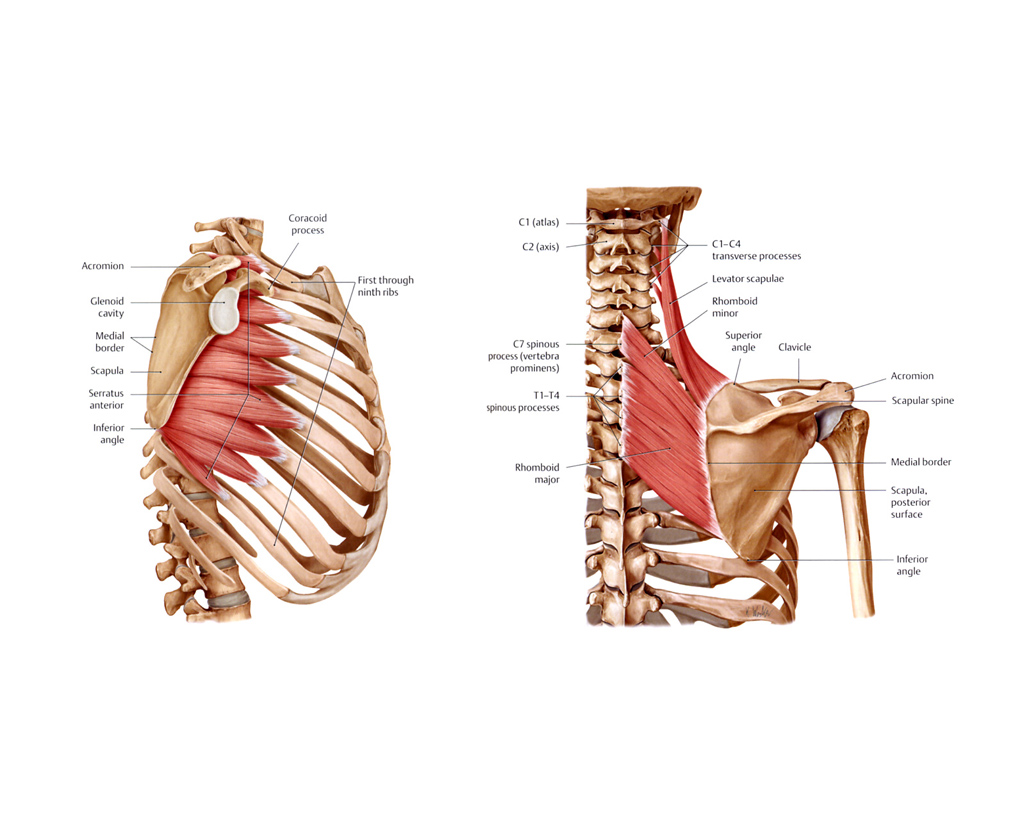
Muscles that comprise the Rotator Cuff
  • The Glenohumeral (shoulder ball and socket) joint has muscles (rotator cuff) that attach it to the scapula
  • Scapula is a "floating bone" which is anchored to the rib cage by the anterior serratus  
  • The scapula to the spine by the rhomboids and the levator scapulae.
  • The spine is stabilized by the core muscles  
If any muscle along that chain is weak, the unit will only function as well as the weakest muscle can tolerate. In other words, the chain is only as strong as its weakest link.
Fortunately, there are many core exercises that can be used to strengthen all of the muscles together as a unit, thereby increasing the ability of the ENTIRE chain.

So here are 3 exercises that you can do to train the kinetic chain of an overhead thrower.

1. Side planks - Side planks train the muscles of the Glenohumeral joint, scapulothoracic joint as well as the lumbar stabilizers in the frontal (lateral) plane. This is one of the best exercises for improving core stability and is a necessity for ANY overhead throwing athlete.
 
2. Supine opposites/ Deadbug - the deadbug trains the muscles of each side of the body to operate independently. This trains the body to prevent rotation and stabilize the core - a REAL strength and control exercise 


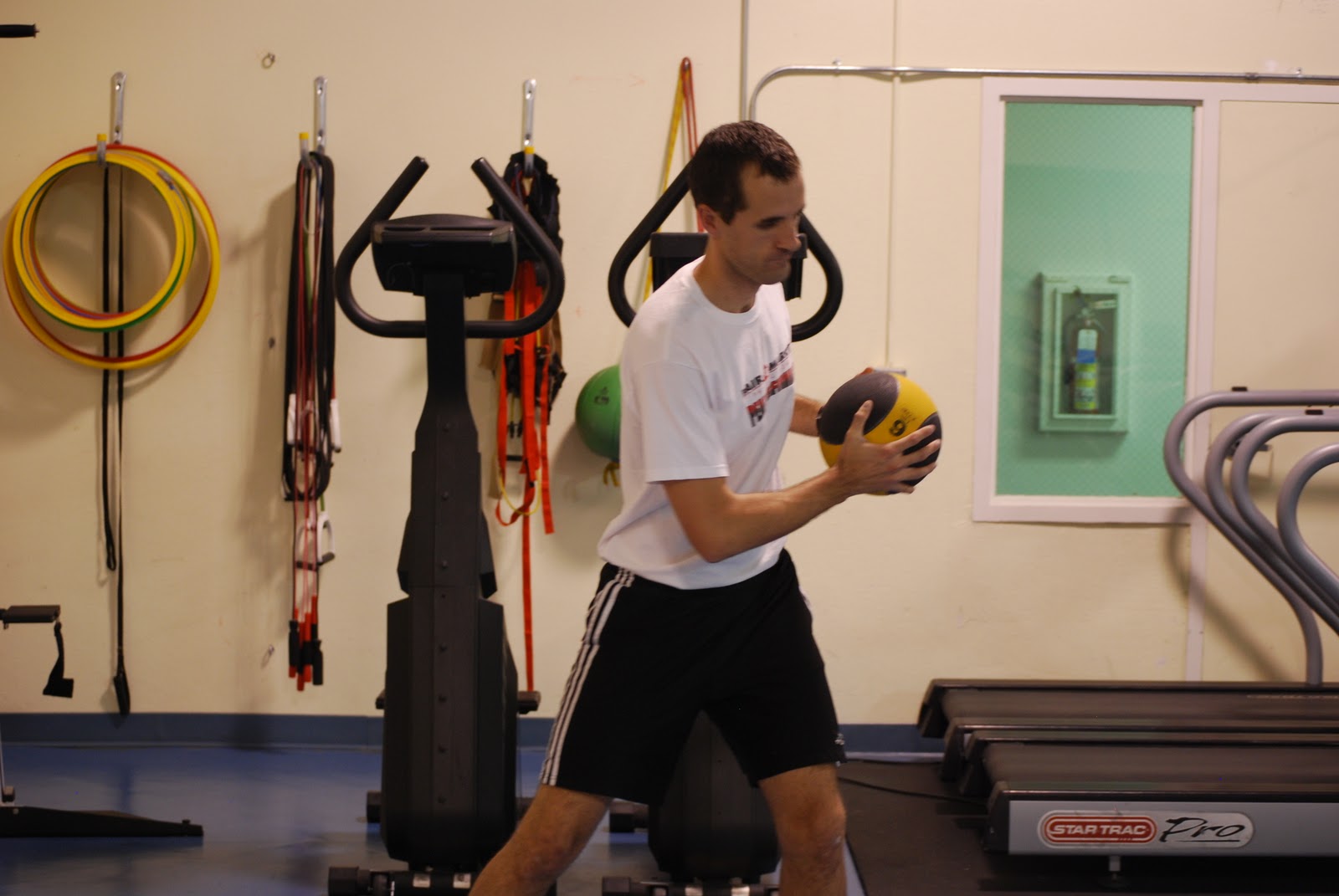
Med Ball Shakers

3. Med ball shakers - Using a medicine ball, take an athletic stance and quickly shake the ball back and forth for 6-10 seconds. You'll know if you are doing it correctly because your abdominals will be on fire. If you're arms are burning then there is a good chance that you are having issues using your abs to initiate motion and instead are using your arms.

These arejust three of the exercises that we have used in our the baseball players we train for speed, agility and quickness here at Pair & Marotta Peak Performance!

To learn more about core training for Baseball and Softball using just your body weight and a bat, get registered for our "On-Field Core Training for Baseball/Softball" workshop on Saturday January 22 from 10am-noon. You'll leave with a TON of valuable tools that you can use on field with your team!!
Email aaron@pairmarotta.com for more information!

Monday, April 13, 2009

Close your eyes, you're not going to want to see this...

With the start of baseball season, we are bound to see the rate of injuries go up. Yes, things happen and accidents occur. But many of these accidents do not have to happen. Many of them can be avoided if we only trained the muscles and reactive systems required to prevent many of them. It almost seems too easy.

Lets start from the ground up: the ankles.

Baseball along with many other sports is played on two feet. It also involves running. For the most part, the players are running on a flat surface. But it never fails you will see an athlete round the bases and sprain an ankle. Why does this occur? I mean he's done it thousands of times before, right?

We have no problem standing flat on our feet. But when we get a little sideways and we are standing on the outside of our feet, our ankle wants to keep on rolling. That is inertia - an object will maintain its path of travel until acted upon by an outside force.

If we can get the nervous system to recognize that our ankle is about to roll and quickly react and fix it, then we can prevent it from rolling. Some of you may have had this happen; you're running and the ankle starts to roll but you catch it and although it scared you, thinking you're about to sprain your ankle, but you caught it and it was nothing more than a scare.

To train this reactive ability, we need to train in what we call a proprioceptively enriched environment. Or simply a stability/balance challenged environment. At Pair & Marotta, we do this by having you stand on a single leg, or closing your eyes or placing you on an unstable surface such as an air disc, half a foam roll, or a airex pad.

This trains the muscles of your ankle to quickly recognize a potentially dangerous situation and react as opposed to having to think about it. The most convenient and beneficial time to work on balance and stability is during warm-ups. Balance on a single leg and reach in different directions, skip in different directions, shuffle and then change direction, run in different directions. These are all good things that will help prevent injury!!

You will see many of these types of exercises in "Peak Preparation: A On-Field Guide to Performance."

Wednesday, April 1, 2009

Are you doing more than just "something"?


I have to tell you guys, I am a big fan of music. But then again, who isn't?

One of my favorite bands is the White Stripes. I know it might be a bit trendy but they are great musicians. What does this have to do with sports performance? What does this have to do with getting stronger, faster, quicker and more powerful?

The White Stripes have a song called Blue Orchid. And in that song, Jack White sings something so profound that it took me till now to get it. What did he sing?

"Something's better than nothing...Something's better than nothing is giving up!"

As an athlete, no... as a person, you should never catch yourself saying, "Well, something is better than nothing."

Something's better than nothing is not giving your all. And not giving your all, is giving up my friend.

So whether you are in school, or you're practicing, or your doing chores around the house or your mowing the lawn, or you are at Pair & Marotta getting your sports training done, give it everything you have. Make it the best you've ever done. Make it something to be proud of, something that when people see it, they are amazed at the effort that went into it.

Sports is all about giving everything you've got. The ones who win, who are champions, who outlast and play their opponents...they out "give" their opponents. Because they have more to give. That is what Pair & Marotta Sports Performance training is all about. We give everything we've got, to give you more. We want you to be so well conditioned, so well athletically trained, so focused on the task at hand, that you give everything and not a drop less.

When you give your all, it says something about you as a person. It says something about your parents, it says something about your friends. Actions speak louder than words. So don't give anything less than 100% and never let anybody hear you say, "something is better than nothing."

Because that my friend, is giving up.
____________________________________________________________________

Below is the workout of the week for your week off. Take it, work on it and give everything you've got.

Circuit type workout (follow each exercise immediately with the next, minimal rest)
  1. Push-ups x 5
  2. Rocket Jumps x 5 (tuck in when on ground, explode arms and legs into a star at highest point of jump)
  3. Mountain climbers x 10
  4. Hip Bridges x 10
  5. Reverse Snow Angels x 10 (lie on belly, keeping arms and legs off the ground and make a snow angel)
  6. Lateral shuffle 10 times each side
Do as many circuits as you can in 15 minutes. Coaches, this is a terrific workout to end a practice with. This is just a sample of what you can expect in "Peak Preparation: An On-Field Training Manual." You'll get that this summer.

Monday, February 16, 2009

Coordinating Coordination

Just about every day players or coaches ask me what they can do to get faster or help their players get faster. The top item I tell them is to work on coordination and stretching. I could talk about both here, but you don't have all day and I don't want to overwhelm parents, players or coaches with a bunch of technical jargon.

So onto the coordination explanation.

Most if not all kids these days are already specializing in sports. I don't want to talk about whether or not I think that is good, I'm just going to explain how it can hinder performance.

When kids begin to specialize at a young age, they start to go through repetitive motions over and over. Many times this goes on for years. And because they specialize, they are not exposed to other stimuli that could be beneficial. Baseball is a prime example of that. 

There is not a lot of running in baseball compared to soccer or football. This unfortunately does not bode well for the young player when he really needs to start running during a game. His body has essentially developed the movement patterns that he trains the most (Pitching and hitting) and everything else just kind of gets left to the wayside.

Running requires coordination: you have to know how far should I extend my knees, how far forward should I lean, how big of an arm swing do I need, should I bend my knees more, should I land on my heel or on the ball of my feet, etc, etc. 

There are many instances of coordination being needed but when  a child specializes they tend to not get exposed to these tasks that demand coordination. So at our In-Season Baseball Training, we are laying a base and developing coordination each and every day by doing this sequence of a warm-up:
  1. We start with the agility ladder. Most of these exercises are designed to get the kids to move their feet and place them in a specific position, while also learning to transfer body weight from one foot to the other.
  2. We then progress to active stretching that requires strength to get through the stretch, but also has a very high balance demand to it. 
  3. Next comes our skipping, bounding and more dynamic warm-up. These require, rhythm and timing, coordination between muscles and muscle groups as well as a spatial awareness that most youth athletes are not exposed to.
  4. We then go into postural exercises and skill development such as the mini-hurdles or rapid response exercises to teach asymmetrical movements while maintaining proper posture.
The one thing about this program is it is highly asymmetrical, meaning that when one side is moving the other side is either not moving, or it is stabilizing or moving at a different rate, in a different direction or through a different range of motion. This is what kids MUST develop in order for them to become better athletes. They need to focus on movement first in different directions, with different tempo's, different ranges and different rhythms. 

If you notice that there is just something off with the movement of you or your athlete, that things just look a little off, odds are it has to do with coordination. And if you really want it to improve, do it more frequently than just at Pair & Marotta. Do the skipping in the back yard, add rapid response exercises to your pre-game warm up, and start working on running and moving in different directions than just those used in baseball. I enjoy baseball. But what I enjoy even more is watching young players become better athletes, not just better ball players.

This is what we do at Pair & Marotta Sports Performance. We teach athletes how to move their body. They are starting to see how amazing their body really is and once they realize that, their potential is unlimited in not only sports, but also in life.

Friday, February 6, 2009

Computers and...Baseball?


We've now started our In-Season Baseball Training Program and one thing is for sure. There are a lot of things that need improvement. And here is one thing I have noticed from working with kids in a learning environment:

They do not think before they move.

When learning a new movement pattern or exercise, especially in a sports training environment, it is very important that a baseball player think about what is about to happen before trying to go through the movement pattern.

So many athletes just try to make the exercise look like the person who demonstrated it. But when players go based off of what it looks like as opposed to how an exercise FEELS, they tend to get it wrong. It's like trying to run a computer program without the necessary software.

The brain is the software. It controls the entire program. It stores the motor programs and cues for going through an exercise. The muscles are the hardware. Now most computers have appropriate hardware to run most programs. However, it is the software you have to buy and upload.

If the software isn't there, then no matter how hard you try to create a program or mimic a program, it's not going to operate correctly. You must have the software for the program to run right.

By going through a Baseball Training Program, like ours at Pair & Marotta Sports Performance in Bakersfield, we are installing the software necessary to make the computer (body) and programs (swing/pitch) run faster and more efficiently.

So before we try to learn an exercise or movement pattern, we need to think about what is going to happen, take the time and effort to feel the exercise in the muscles and make sure that you are feeling what you should be feeling.

It's like I have said for so long, an exercise can look right but feel completely wrong. However, it is virtually impossible for a movement pattern to feel right and look wrong. This can be applied to a baseball swing.

So many people are paying for their kids to get hitting lessons. And many coaches are concerned with only the visual aspect of the swing. Only those who understand movement science will ask how the swing feels and which muscles the batter feels it in. If you're not doing focusing on the causes of Movement First, then you're simply putting a band-aid over a larger problem.

Here is the take away for the day: Before paying to give your child the perfect baseball swing, pitch, or lead off, make sure they can go through the basic movements. Make sure they can squat, lunge, rotate and reach before trying to change the swing. Or else you might just be putting a band-aid over something that has deeper causes.

Thursday, January 22, 2009

The In-Season Dilemma


The baseball season is already here!!


Local high schools are getting ready to start practicing and many youth leagues are already on the diamond!! They practice and play, play and practice. They practice hitting, bunting, fielding, throwing, leading off, pickoff moves and learn the coaches signs
from third base.
But lets take a step back. What is it that allows kids to play baseball? More generally, what is it that baseball requires to be good at? Movement. And that is what we at Pair & Marotta Sport Performance specialize in: Teaching Movement.

Movement is what allows baseball and softball players to swing a bat regarless of whether they hit the ball. But rarely do kids focus on just movement. They would rather make contact with an ugly swing than strikeout with a powerful swing. Don't believe me? Watch a youth athlete in the on-deck circle and then watch them at the plate. When there is no ball coming at them, their swing is simply a flop of the bat. Watch them when they step out of the box between pitches. These are the times to be focusing on a good swing.

So how does Pair & Marotta Sports Performance fix that? How do we work on the quality of the swing without the stress of them worrying about hitting a ball, but rather focusing on a good quality swing? We teach hip rotation and extension to drive the swing. We teach athletes how to put a stretch in the muscle, then to unleash it by getting a good solid contraction out of the muscle. We start in a squat to load the hips, then explode out and release the elastic energy we just created.

This is just one example of the types of exercises each athlete will be performing while at Pair & Marotta Sport Performance.

Many people think when the season begins, the strength program must stop. This could not be further from the truth. Strength training during the season actually improves the sport skills that are being taught while at practice. Watch as the athleticism of a player who trains during the season improves, while that of others is stagnant or declining.

Pair & Marotta Sports Performance In-Season Program starts February 2nd. If you're in Bakersfield and would like to be a part of it, email me at aaron@pairmarotta.com or call 661-912-9991. We are capping each group at 10 players, so don't wait too long!!

Wednesday, October 22, 2008

Picking Up the Pieces and Looking to 2009

With the World Series starting tonight, the two best teams in Major League Baseball will square off over the next week. What will be left is one team riding a float down main street of their respective city, and the other picking up the pieces of a season that couldn't be finished.

And just like you need to be doing, they are soon going to start preparing for the 2009 season. They will start getting stronger, faster, quicker and more powerful. Because they want to last through the 2009 post-season.

A strength and conditioning program isn't just for the elite. It is for those who desire to be elite. It is for those who want nothing less than the most out of their body, and it is for those who don't consider the season a success unless they win their last game.

Pair & Marotta Sports Performance has the program you and your team needs. Our facility is specifically designed and set up to accommodate teams of over 25 athletes. If you want there to be no question in who the best team on the field is, you will find your self in here.

In order to be the best, you've got to train with purpose and with intensity. Or as we like to say, you need to Train Like You Mean It.