Showing posts with label pitching. Show all posts

Tuesday, March 29, 2011

Peak Performers

We have had quite a few great athletes come through Pair & Marotta Peak Performance over the past few years. And one thing that never fails is the outcome of the hard workers. Those that are the most consistent see the greatest results. The ones that are the first ones in, last ones out and always trying to get better will out perform those with raw talent.

But the really interesting thing is that the ones who are the most consistent, are the hard workers! Those who have a great work ethic won't be floating in and out, here for 3 weeks then out for 3 months. 

James Barragan pitches against Liberty.
And its tough to tell the talented ones that talent will only take you so far. It almost seems like talent can be a liability because it makes them think that their talent will steadily increase and their performance will improve because of it. But the less talented ones will always be the underdog that we at P&M love. These are the ones who we know that no matter where they go in life, they'll succeed because they won't give up.

Yes, some kids have greater potential because of their genetics, but natural talent has a ceiling - hard work doesn't. Natural talent will take you far, but hard work will take you further.


Another P&M athlete, James Barragan made the paper this past week as he had a stellar pitching performance against Liberty. James pitched a 3-hit complete game shutout the other night and gave Stockdale its first league win of the year.


Great job James!

Friday, January 7, 2011

3 Things you NEED to know about core training...

Often times we read things and get so excited about them that we forget where we are reading them. We forget that Men's Health needs to ultimately sell magazines to stay in business. So they are going to print things that people like.

I used to subscribe to Men's Health. But then I started noticing a lot of similar articles popping up and also a lot of filler and fluff.

In each issue they do have a few well put together articles. Many having to do with grooming, sex and then of course getting ripped in 15 minutes a day. In fact I remember one issue had what was called the "Ripped in the Shower." It consisted of stretching your chest, some body weight squats, calf stretching and some isometrics for the biceps and triceps.

One of the guys that Men's Health looks to for information on back fitness is Dr. Stuart McGill. We at Pair & Marotta Physical Therapy also look to him (and a few others) when we want to see what the newest research in back health is saying.

Dr. McGill has a book out titled "Ultimate Back Fitness and Performance." I've been using the information provided in it with clients and patients for a little over a year now and the results are amazing!

So here are 3 things that we've gotten from "Ultimate Back Fitness and Performance":

  1. You have to control the spine before you can hope to unleash its ability. Too many coaches are busy doing exercises that create motion at the lower spine instead of teaching athletes how to control the spine. Without control, power is useless!
  2. The spine is not meant to bend and twist. Yes it can bend and twist. But look at its anatomy and you see that the joints of the spine are not like any other joint in the body. They are not a ball and socket, not a hinge, not a saddle, and not condylar. If anything it is a gliding joint. However the muscles connecting each joint are very intricate and stiff. The spine is there as a center stabilizing column for the rest of the body to move around, rather than itself moving in all directions.
  3. Shoulder and knee injuries are highly correlated with poor spine health and stability. We see a lot of baseball pitchers who have shoulder injuries and basketball players who have knee injuries and time and time again the same trend is seen: poor postural control and stabilization. As I stated in the point above the spine is meant to be stable. If the spine is not stable then the arms and legs have nothing to anchor too. If there is nothing to anchor too its like hitching your horse to a log lying on the ground: sure its attached, but there is not security/stability.
Lucky for the baseball and softball coaches here in Bakersfield, Pair & Marotta Peak Performance is hosting a 2-hour workshop titled "On-Field Core Training for Baseball/Softball" where we will discuss how to implement a core training program into your practices. The workshop will demonstrate field tests to use, core training sequencing and ultimately power training for the core using just a baseball bat and a partner.

This is a free workshop that will take place on Saturday January 22nd from 10am-noon at our Peak Performance facility at 5337 Truxtun Ave. 

For more information or to register contact Aaron@pairmarotta.com

Tuesday, September 21, 2010

Is a pitcher REALLY an athlete?

A lot of people have a difficult time justifying the use of the word "athlete" when it comes to pitchers. There logic states that if a guy can be 40 lbs overweight and be a "professional" is it really an "athletic" position? Or is it simply an athletic skill? 

In other words, what does it really take to be a pitcher?

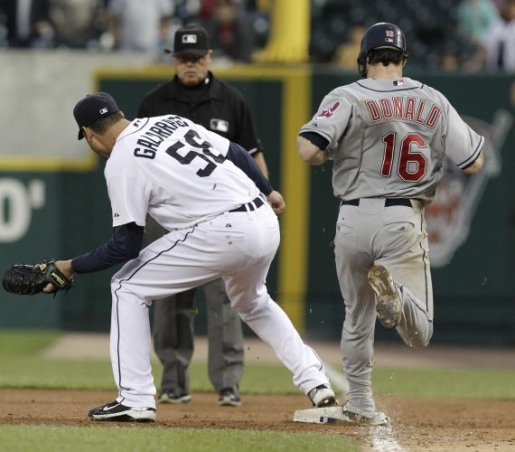
If we watch pitchers, most of the time they simply chuck and duck. But then consider what they need to be able to do after they duck: they may have to field the ball, sprint to first, sprint to back-up home or even dive to get out of the way of a ball.

That's quite a lot! 

So we've identified what a pitcher has to be able to do in addition to throwing. And there are many great pitching coaches who can teach a player how to pitch. But do coaches ever work on actually playing the position?

That is something that may require a bit more skill. When you have to react that quick, that infrequently, there may be some additional training that is necessary. First off, simply reaction time is start. But don't go trying to hit line drives right at your athletes for the sake of reaction time training. There are safer ways to go about it

The second part of this should be footwork and foot speed. Improving a pitchers foot speed is paramount in allowing them to react quickly to the ball as well as find the bag when covering first or field a ball that comes to them. 


These are very underrated qualities in a pitcher. Many people tend to forget that as soon as the ball leaves his hand, he is a position player. As such, his training should reflect that. Foot speed can be developed by using low boxes, agility drills, ladder drills, partner mirror drills and rapid response-to-sprint drills.


At Pair & Marotta Peak Performance this is what we do. We train players to be athletes, not just pitchers. We currently have our Off-Season Baseball/Softball Training Camp that meets on Monday, Wednesday and Friday's from 3:30-5pm. If you've got the desire to improve your foot speed, reaction time and agility, then we've got the program that will do it.


For more information, contact me at aaron@pairmarotta.com or call 661-912-9991.

Monday, April 13, 2009

Close your eyes, you're not going to want to see this...

With the start of baseball season, we are bound to see the rate of injuries go up. Yes, things happen and accidents occur. But many of these accidents do not have to happen. Many of them can be avoided if we only trained the muscles and reactive systems required to prevent many of them. It almost seems too easy.

Lets start from the ground up: the ankles.

Baseball along with many other sports is played on two feet. It also involves running. For the most part, the players are running on a flat surface. But it never fails you will see an athlete round the bases and sprain an ankle. Why does this occur? I mean he's done it thousands of times before, right?

We have no problem standing flat on our feet. But when we get a little sideways and we are standing on the outside of our feet, our ankle wants to keep on rolling. That is inertia - an object will maintain its path of travel until acted upon by an outside force.

If we can get the nervous system to recognize that our ankle is about to roll and quickly react and fix it, then we can prevent it from rolling. Some of you may have had this happen; you're running and the ankle starts to roll but you catch it and although it scared you, thinking you're about to sprain your ankle, but you caught it and it was nothing more than a scare.

To train this reactive ability, we need to train in what we call a proprioceptively enriched environment. Or simply a stability/balance challenged environment. At Pair & Marotta, we do this by having you stand on a single leg, or closing your eyes or placing you on an unstable surface such as an air disc, half a foam roll, or a airex pad.

This trains the muscles of your ankle to quickly recognize a potentially dangerous situation and react as opposed to having to think about it. The most convenient and beneficial time to work on balance and stability is during warm-ups. Balance on a single leg and reach in different directions, skip in different directions, shuffle and then change direction, run in different directions. These are all good things that will help prevent injury!!

You will see many of these types of exercises in "Peak Preparation: A On-Field Guide to Performance."