Watching the World Series has been just a blast, seeing as how the Phillies are up 3 games to 1. But one of the most interesting things has been the defense on both sides. In game 3 we saw a game to remember: a 45 year old pitcher Jamie Moyer made one heck of a play when diving to try and get Carl Crawford out and BJ Upton stole his way from first all the way to home!!
The speed at which these guys play the game is amazing. But to prepare for this type of play, players from both teams have been training in-season, post-season and they really hit it hard in the off-season. There is so much design that must go into a training program to make sure you are the best. And then after that, the best of the best.
So I ask, are you training to be the best? Or are you taking a "whatever" approach to baseball training? Right now at Pair & Marotta Sport Performance we are just finishing up our cycle where we have been training to add muscle. Our next phase is strength/speed focus. We are going to be doing a lot of speed training. Here is a quick sample of the type of stuff we have been doing.
If you aren't training like this, then you should be. It's fun, it's effective, and we guarantee you'll be faster. What are you waiting for? Stop by and sign up today!!
www.pairmarotta.com
Monday, October 27, 2008


Wednesday, October 22, 2008
Picking Up the Pieces and Looking to 2009
With the World Series starting tonight, the two best teams in Major League B aseball will square off over the next week. What will be left is one team riding a float down main street of their respective city, and the other picking up the pieces of a season that couldn't be finished.
And just like you need to be doing, they are soon going to start preparing for the 2009 season. They will start getting stronger, faster, quicker and more powerful. Because they want to last through the 2009 post-season.
A strength and conditioning program isn't just for the elite. It is for those who desire to be elite. It is for those who want nothing less than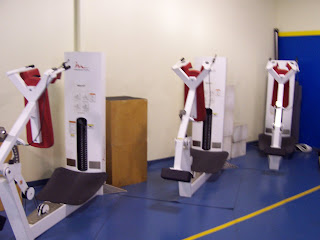 the most out of their body, and it is for those who don't consider the season a success unless they win their last game.
Pair & Marotta Sports Performance has the program you and your team needs. Our facility is specifically designed and set up to accommodate teams of over 25 athletes. If you want there to be no question in who the best team on the field is, you will find your self in here.
In order to be the best, you've got to train with purpose and with intensity. Or as we like to say, you need to Train Like You Mean It.
 aseball will square off over the next week. What will be left is one team riding a float down main street of their respective city, and the other picking up the pieces of a season that couldn't be finished.
And just like you need to be doing, they are soon going to start preparing for the 2009 season. They will start getting stronger, faster, quicker and more powerful. Because they want to last through the 2009 post-season.
A strength and conditioning program isn't just for the elite. It is for those who desire to be elite. It is for those who want nothing less than
 the most out of their body, and it is for those who don't consider the season a success unless they win their last game.
Pair & Marotta Sports Performance has the program you and your team needs. Our facility is specifically designed and set up to accommodate teams of over 25 athletes. If you want there to be no question in who the best team on the field is, you will find your self in here.

In order to be the best, you've got to train with purpose and with intensity. Or as we like to say, you need to Train Like You Mean It.
Tuesday, September 9, 2008
Like an Old T-Shirt
Baseball is a long season. And like an old T-shirt you can get tired and worn. Playing more than 20 games a month is not an easy task when an athlete is involved in a strength and conditioning program. Imagine the ball player who isn't on a strength and conditioning program!!
How many pitchers this year have visited the disabled list? How many batters? How many ball players are out for the season? How many ball players have had their career's effectively ended due to injury this year? We may never know. There are a lot of injuries in baseball. Why do you think they have so many minor league teams? Because they have to constantly have a quality back-up for even the back-ups. Check out what Dustin Pedroia has to say about strength and conditioning.
But what if you were determined to not let the injury bug bite you? That would be a good thing right? Good, we are on the same page. Now where do you start? You start by getting involved in a quality strength and conditioning program at Pair and Marotta Sport Performance and Fitness.
www.pairmarotta.com
And not a strength program designed by just anybody. You need a program by somebody who has experience writing programs for baseball. Somebody who knows how the body works as a unit. Don't just trust anybody. Don't trust Joe Schmo simply because he "played at the level, and knows what it takes." Trust somebody who knows movement, can teach movement and can communicate effectively with their athletes.
Just because somebody played a sport does not make them a good coach. There are plenty of ball players who are horrible coaches. And many of the best coaches never played the sport professionally or even at the collegiate level. But they understand the movement of the game and how to get the best out of their players.
Don't wait until college to get into a strength and conditioning program. Because odds are, everyone else on the team was on a structured program in high school.
www.pairmarotta.com
We have a program with your name on it that will keep you healthy and playing at your best year round. Don't wait, we have already started our fall program.
How many pitchers this year have visited the disabled list? How many batters? How many ball players are out for the season? How many ball players have had their career's effectively ended due to injury this year? We may never know. There are a lot of injuries in baseball. Why do you think they have so many minor league teams? Because they have to constantly have a quality back-up for even the back-ups. Check out what Dustin Pedroia has to say about strength and conditioning.
But what if you were determined to not let the injury bug bite you? That would be a good thing right? Good, we are on the same page. Now where do you start? You start by getting involved in a quality strength and conditioning program at Pair and Marotta Sport Performance and Fitness.
www.pairmarotta.com
And not a strength program designed by just anybody. You need a program by somebody who has experience writing programs for baseball. Somebody who knows how the body works as a unit. Don't just trust anybody. Don't trust Joe Schmo simply because he "played at the level, and knows what it takes." Trust somebody who knows movement, can teach movement and can communicate effectively with their athletes.
Just because somebody played a sport does not make them a good coach. There are plenty of ball players who are horrible coaches. And many of the best coaches never played the sport professionally or even at the collegiate level. But they understand the movement of the game and how to get the best out of their players.
Don't wait until college to get into a strength and conditioning program. Because odds are, everyone else on the team was on a structured program in high school.
www.pairmarotta.com
We have a program with your name on it that will keep you healthy and playing at your best year round. Don't wait, we have already started our fall program.
Tuesday, August 26, 2008
Is there a Limit??
If you've watched Usain Bolt run, you know the guy is fast. At the Olympics in Beijing, he smashed records for the 100m and 200m dash. This video is of him setting his first World Record at 9.72.
Bolt is not just fast, he is a marvel and a contradiction to physics and what we thought were human biomechanics. He is 6'5". Normally that is considered too tall because longer limbs move slower. They have longer reach but require a little longer to get through a cycle.
Sure there are some fast guys who are tall, but at the olympics, at such a high level of performance all but 1 do not compare. What this demonstrates is that even when everybody says it can't be done, that you're just not cut out for it... you need to keep pushing. You might not break world records, but you'll never know if you walk away. Push and push harder. Work and work harder, it will be rewarded.
Here is a link regarding the statistics of human speed limits. The article states that based on muscle types and limb lengths Bolt is an unusual specimin. But the article also states people will run faster!! Can you believe that!!!
http://blog.wired.com/wiredscience/2008/08/bolt-is-freaky.html?npu=1&mbid=yhp
Work and work harder, push and push harder. The only thing that will come of it is you going further than you thought possible. Where is your Limit?
Bolt is not just fast, he is a marvel and a contradiction to physics and what we thought were human biomechanics. He is 6'5". Normally that is considered too tall because longer limbs move slower. They have longer reach but require a little longer to get through a cycle.
Sure there are some fast guys who are tall, but at the olympics, at such a high level of performance all but 1 do not compare. What this demonstrates is that even when everybody says it can't be done, that you're just not cut out for it... you need to keep pushing. You might not break world records, but you'll never know if you walk away. Push and push harder. Work and work harder, it will be rewarded.
Here is a link regarding the statistics of human speed limits. The article states that based on muscle types and limb lengths Bolt is an unusual specimin. But the article also states people will run faster!! Can you believe that!!!
http://blog.wired.com/wiredscience/2008/08/bolt-is-freaky.html?npu=1&mbid=yhp
Work and work harder, push and push harder. The only thing that will come of it is you going further than you thought possible. Where is your Limit?
Monday, August 11, 2008
Always Thinking About Eating
As I was growing up, I ate a lot. Generally my brothers and I were asking about when our next meal was, even if we had just finished one. Dinner was always our favorite because it gave us something to look forward to for most of the day. Being that we were kids, we didn’t really get much say in what we ate for dinner, as our job was unpaid (going to school rarely is a paid occupation) and we got what was put in front of us.
However, at this point in our lives, we are on the other end of that equation. We are all adults and we are the ones making decisions about the food we eat. We make these decisions not only for ourselves, but often for our families as well. I was thinking about this the other day and realized how easy it is in our society to eat without thinking. Generally our meal/food choices are often based on convenience instead of content. What I am suggesting here isn’t a radical shift in philosophy, only a shift in how we approach food and eating.
Food cannot be something we do out of habit. That is what has gotten our society in the overweight mess it is in. We need to consider our meals far ahead of when we eat them. Planning meals must become something we put more emphasis on and more effort into. By planning out our meals for the week we know and are able to make healthier decisions that will aid us in shaping our bodies and constructing a healthy machine!!
Let’s say a week is way too far in advance for you to plan your meals. Start with planning out your meals for the day. Before you leave the house in the morning, you need to know what you will eat for snacks, lunch, and dinner. By preparing your day and thinking about what you will eat, it is easier to make healthier choices.
For example, if you are on your way home and already know that you and your family are having chicken and wild rice tonight, there will be no reason to stop off for the $5.99 pizza for your family. Obviously chicken and wild rice is much healthier than pizza. So, plan out your meals for the day. Take your trail mix, fruit, yogurt, string cheese, or snacks with you to work so you are not tempted to make a trip to the candy machine when you need that afternoon energy kick!! Have your bottle of water next to you so when you are thirsty, that call from the soda machine can be ignored.
By planning and preparing we are better able to make smarter choices about what we eat and drink. I always thought it was corny, but as I go through life this old adage makes more and more sense:
If you fail to plan, you are planning to fail.
However, at this point in our lives, we are on the other end of that equation. We are all adults and we are the ones making decisions about the food we eat. We make these decisions not only for ourselves, but often for our families as well. I was thinking about this the other day and realized how easy it is in our society to eat without thinking. Generally our meal/food choices are often based on convenience instead of content. What I am suggesting here isn’t a radical shift in philosophy, only a shift in how we approach food and eating.
Food cannot be something we do out of habit. That is what has gotten our society in the overweight mess it is in. We need to consider our meals far ahead of when we eat them. Planning meals must become something we put more emphasis on and more effort into. By planning out our meals for the week we know and are able to make healthier decisions that will aid us in shaping our bodies and constructing a healthy machine!!
Let’s say a week is way too far in advance for you to plan your meals. Start with planning out your meals for the day. Before you leave the house in the morning, you need to know what you will eat for snacks, lunch, and dinner. By preparing your day and thinking about what you will eat, it is easier to make healthier choices.
For example, if you are on your way home and already know that you and your family are having chicken and wild rice tonight, there will be no reason to stop off for the $5.99 pizza for your family. Obviously chicken and wild rice is much healthier than pizza. So, plan out your meals for the day. Take your trail mix, fruit, yogurt, string cheese, or snacks with you to work so you are not tempted to make a trip to the candy machine when you need that afternoon energy kick!! Have your bottle of water next to you so when you are thirsty, that call from the soda machine can be ignored.
By planning and preparing we are better able to make smarter choices about what we eat and drink. I always thought it was corny, but as I go through life this old adage makes more and more sense:
If you fail to plan, you are planning to fail.
Monday, July 28, 2008
Changing Directions
A lot of times as an athlete we get too focused on numbers and test's and times and forget about how we actually perform. Performance on the field is often measured in quantity, but change in performance can also be measured in quality. How well does a person move, or how much better does this kid move than 3 months ago?
Changing direction is one of those things that is qualitative. It is very hard to time change of direction alone. But if you're looking for it, the change can stand out like a sunflower in the outfield.
Changing direction is all about angles. The most glaring culprit of poor performance is the inability to change directions efficiently without wasting movement. Whether it is during linear transition or lateral change in direction, many athletes are "too tall" when changing direction and have a lot of wasted movement. Athletes will lack stability through the truck and hips and lose a lot of energy transfer due to what we call upper body sway. This occurs when the lower body plants and attempts to push back the other way, but the upper body continue's moving opposite to where the lower body is now attempting to go. When you see this it looks like the lower body is dragging the upper body back the other way with it.
Upper body sway results in a lot (relatively speaking) of wasted time as the upper body must now get pulled back and dragged the other way. This is one very good reason why situps and crunches are a waste of time. They do not train the core muscles to be stable during change of direction. Planks, side planks and lateral stability exercise's are going to be the agent of change.
Changing directions will also involve maintaining a low ground position. This allows the proper angle to be taken so that force is transfered down through the leg and into the ground horizontally rather than vertically. What happens when we push our legs quickly into the ground directly below us? We jump straight into the air.
To change direction, we must produce force that transfer's down and horizontally so that we may move in the opposite direction of our force production. We are pushing ourselves away from the ground. Change the way we teach lateral change of direction and we will change the speed of our athletes.
Changing direction is one of those things that is qualitative. It is very hard to time change of direction alone. But if you're looking for it, the change can stand out like a sunflower in the outfield.
Changing direction is all about angles. The most glaring culprit of poor performance is the inability to change directions efficiently without wasting movement. Whether it is during linear transition or lateral change in direction, many athletes are "too tall" when changing direction and have a lot of wasted movement. Athletes will lack stability through the truck and hips and lose a lot of energy transfer due to what we call upper body sway. This occurs when the lower body plants and attempts to push back the other way, but the upper body continue's moving opposite to where the lower body is now attempting to go. When you see this it looks like the lower body is dragging the upper body back the other way with it.
Upper body sway results in a lot (relatively speaking) of wasted time as the upper body must now get pulled back and dragged the other way. This is one very good reason why situps and crunches are a waste of time. They do not train the core muscles to be stable during change of direction. Planks, side planks and lateral stability exercise's are going to be the agent of change.
Changing directions will also involve maintaining a low ground position. This allows the proper angle to be taken so that force is transfered down through the leg and into the ground horizontally rather than vertically. What happens when we push our legs quickly into the ground directly below us? We jump straight into the air.
To change direction, we must produce force that transfer's down and horizontally so that we may move in the opposite direction of our force production. We are pushing ourselves away from the ground. Change the way we teach lateral change of direction and we will change the speed of our athletes.
Thursday, July 3, 2008
Pool Time
Our summer Speed, Strength & Power (SSP) Camp just wrapped up its fourth week. All the kids are moving more efficiently. Which translates to faster foot speed and less fatigue. Some are learning faster than others but the interesting thing is how much faster the younger kids are learning than the older kids.
This is probably because we have unlearn all the bad habits the older kids have while with younger kids, there are not many bad habits to fix. So things are going good. But today they got great.
All 4 groups met out at the pool at CSUB. Most thought we would be swimming all day long. So they were kind of excited, but mostly they were just looking forward to getting out of the bakersfield heat.
What they got was more than they bargained for.
The beauty of perfoming speed and power drills in the water is that it slows everything down and makes it much safer to do plyometric exercises and speed exercises. The water produces the resistive forces against the jumps and movement, but also produces the force that slows the athlete down.
Some may say, well doesn't moving slow produce slower players. Well yes and no. If athletes are chronically using heavy resistance that does not allow for use of the entire muscle contraction and speed spectrum then you will start to see a decrease in movement speed and power. But when providing resistance such as water the athletes intend to contract quickly and the water simply slows them down. They are not moving at "slow" speeds. Simply slower than out of water.
Give it a shot. I'm going to have 40 high school athletes that will have an entirely new view of aquatic exercise.
This is probably because we have unlearn all the bad habits the older kids have while with younger kids, there are not many bad habits to fix. So things are going good. But today they got great.
All 4 groups met out at the pool at CSUB. Most thought we would be swimming all day long. So they were kind of excited, but mostly they were just looking forward to getting out of the bakersfield heat.
What they got was more than they bargained for.
The beauty of perfoming speed and power drills in the water is that it slows everything down and makes it much safer to do plyometric exercises and speed exercises. The water produces the resistive forces against the jumps and movement, but also produces the force that slows the athlete down.
Some may say, well doesn't moving slow produce slower players. Well yes and no. If athletes are chronically using heavy resistance that does not allow for use of the entire muscle contraction and speed spectrum then you will start to see a decrease in movement speed and power. But when providing resistance such as water the athletes intend to contract quickly and the water simply slows them down. They are not moving at "slow" speeds. Simply slower than out of water.
Give it a shot. I'm going to have 40 high school athletes that will have an entirely new view of aquatic exercise.
Subscribe to:
Posts (Atom)