Showing posts with label agility. Show all posts

Thursday, June 23, 2011

Whatever you can do, they can do better...

We are now into the 3rd week of our Summer Speed, Strength and Power (SSP) Camps and a few things are very apparent.

1. The younger kids are, the quicker they seem to learn. In just two weeks of training, the camp we have been running for NOR has seen some amazing improvements! From running technique to deceleration to landing technique, these kids have improved by amounts I was not expecting! And this keeps them safer during play, as well as improves their running speed, lateral movement and overall fun!

2. The girls are just crushing the boys in each of our 3 camps. The average ratio of boys:girls in our camps are 2:1. Our NOR camp has just 1 girl out of 14 kids in the camp. Yet the girls CONSISTENTLY out-perform the boys in acceleration, agility, foot-speed and quickness. The only thing the boys have over the girls is strength. And even then if we measure strength relative to body weight, the girls are almost even with the boys.

3. We need to do more of these. Almost daily I hear from the parents how much their kids enjoy the program and they ask if we do this during the school year. We absolutely do these during the school year. But it seems that practice and games for 3 different baseball leagues that Junior is signed up for takes precedence over movement skill training. Remember, movement skills are the foundation for sports skills. If an athlete has poor movement skills, then sport skills are going to be more difficult to teach. If a child can control their body with precision, then teaching sport skills becomes infinitely easier. Heck, it'll make the most basic instruction have a major impact and sport coaches will think they are all of a sudden Vince Lombardi.

So we will be starting a second Summer SSP camp for the junior group. The new camp will start on July 12 and run through August 4th. Meeting times are Tues/Thurs from 1-2:30. Ages for this camp are from 8-12. We would love to have more baseball and soccer players showing up. Although this camp is open to athletes of all sports.

If you have any questions about the Speed, Strength and Power Camp or just general questions about speed, agility and quickness, feel free to send us an email at aaron@pairmarotta.com! We hope to see you on July 12th!

Tuesday, May 17, 2011

The best way to train speed...

Many sports performance coaches, trainers and facilities say they are "research based." But often times their research consists of nothing more than a quick perusing of YouTube to see what the latest gadget is.

But we at Pair & Marotta do read A LOT of research. We understand how specific exercises train the muscular system and what techniques work the best. So today we'll cover a very HOT topic: Methods for Speed Training.

Everybody loves speed. They love to watch players literally move like electricity and yet do it so smoothly. But how do we train it? Should we use parachutes? Bands? Sleds? Hills?

In the most recent edition of the "Strength & Conditioning Journal" Matthew Behrens, MS and Shawn Simonson, EdD reviewed the options for improving sprint speed. Here is my brief summary.

The first point is that there are two parts to improving speed: Stride frequency and stride length. The authors state that assisted sprinting is used to improve stride rate. Stride rate is otherwise known as the speed that the legs are moving. The legs can move fast, but if they aren't taking long enough steps, then they're literally just "spinning their wheels."

Over speed training can be accomplished using various methods. The first is to be towed. To do this you'll need 2 people or a fixed anchor point. Generally an elastic band is hooked to 2 athletes and the person in the back runs at supra-maximal speeds. I generally describe it to athletes as "running faster than you ever have before." Obviously without the demand on the legs to push harder, they just have to keep up with the body being towed.

The second method the researchers discuss is high-speed treadmill sprinting. This has been demonstrated to be effective, but is usually cost-prohibited in addition to restricting training to 1 person at a time. 

Downhill training is also effective but only at specific angles. The problem with downhill training is that the slope should be a maximum of 2-3 degrees. Usually finding a slope long enough at this angle becomes a problem.

Behrens and Simonson recommend that the best recommendation is assisted towing. This still allows the athlete an acceleration phase but with a much faster top end. One area of concern with over-speed assisted training is the risk of hamstring strains due to a braking effect. If the leg extends too far out during the pull-through of the running cycle, the hamstring attempts to slow the body down and often this is where we see a multitude of hamstring injuries.

Assisted sprinting is used to develop stride frequency. On the other end of the spectrum is resisted sprinting. Resisted sprinting is used to develop stride strength and length. The only 2 options the authors give for resisted training is resisted towing and uphill sprints. 

Resisted Sprinting
The concern regarding resisted sprinting is that if the resistance is too great, sprint mechanics will be altered and as a result the transfer over to normal sprinting will not be as great. As a result, parachutes have been developed as they provide resistance, but not so much that the mechanics are changed. Finding an appropriate hill is also problematic as too steep of an incline will surely change sprinting mechanics.

Although sprint training might seem simple, it is a highly complex topic that takes proper prescription of exercise and drills. Think of training like a prescription medicine. If the dosage is too high, there will be severe side effects and the medicine will be ineffective. If the dosage is too low, the medicine will have minimal effect. In order to train athletes to be their best, you must have the correct prescription.

Fortunately, Pair & Marotta Peak Performance training has the solution: Summer Speed, Strength & Power (SSP) Camp. By attending this 6-week camp, your athletes will get faster, stronger, more powerful, more resistant to injury and have a refined work ethic. We have 2 camps, one for junior athletes age 8-12, and a high school camp for athletes ages 13-18. Camps start June 6. For more information and costs, please contact Aaron@pairmarotta.com or call 661-912-9991 or visit www.pairmarotta.com/fitness.

Monday, March 28, 2011

What's the key to improved QUICKNESS and AGILITY?

Balance.

No, not stand on a single leg, close your eyes and touch your nose balance. But balance between strength and power training.

What is the difference? Well if I asked you to describe strength training, how would you describe it? Most have the picture to the left in their mind. Lift as much weight as you can, regardless of speed. Actually the heavier you lift, the slower the movement.

Now what is power training? Power the same but has a time component. Power is the amount of weight lifted x distance divided by the time taken to lift it, or (force x distance)/time.

Some people claim that if you lift heavy, you lift slow and as a result you won't get any faster or more powerful. This group tends to stay away from heavy lifting and focuses strictly on plyometrics, agility training and reaction time training. These are all good attributes to have in a sports training program.

But by leaving the heavy lifting out, they are missing a very crucial component to their programs!!

Which component?? STRENGTH!

See strength (or in other terms work) is simply a force x distance. So it is in itself a component of power! If you have no strength, then this will directly influence your ability to move fast. After all, its not simply how fast you can move nothing, but instead its how fast can you move your body weight (most sports aren't played wearing a weighted vest).

If an athlete weighs 180 lbs, well he better be able to move and control not only his own weight, but also the added force from the momentum/inertia created by his 180 lbs moving quickly.

Heavy resistance training is a key component to being able to prevent injuries because most non-contact injuries occur during the eccentric or deceleration part of sports. Strength training improves the ability of muscle to control weight external to a players own body weight. 

Look at the video below, as quick as he is, he's also amazingly strong for his size!


Do you think he was able to change direction multiple time by working on speed and agility alone? No. Strength training plays a huge role!!

Then there are some who say that strength is all that matters. This can be countered with the principle of specificity. Specificity states that a person will adapt specifically to the demands placed on the body. So if you teach the muscle to contract with high amounts of force, but it contracts slowly, you'll see a person who is slow, but strong. So you really have to find the balance. 

In sports, especially baseball, we need to find the balance between the two.

At Pair & Marotta Peak Performance do just this! During our FAST Forward workouts, we spend the first 45 minutes of our workout on speed and agility training and the final 45 minutes on strength and flexibility training. And we see some amazing results! Want to come take a look?

Send me an email and let me know you'll be coming by! We would love to see you.

Wednesday, January 12, 2011

3 things to save your player's shoulders...

Shoulder injuries are the most common injuries in baseball and softball players. A study in 1999 surveyed 500 youth pitchers and found that over half of them sustained some time of shoulder or elbow pain during the course of the season. The study found that the more pitches thrown correlated with an increase in elbow and shoulder pain. 

On first thought it would seem that we simply need to strengthen the shoulders and elbows of these pitchers. But lets look at things a little deeper and connect the chain and see where it ends up:
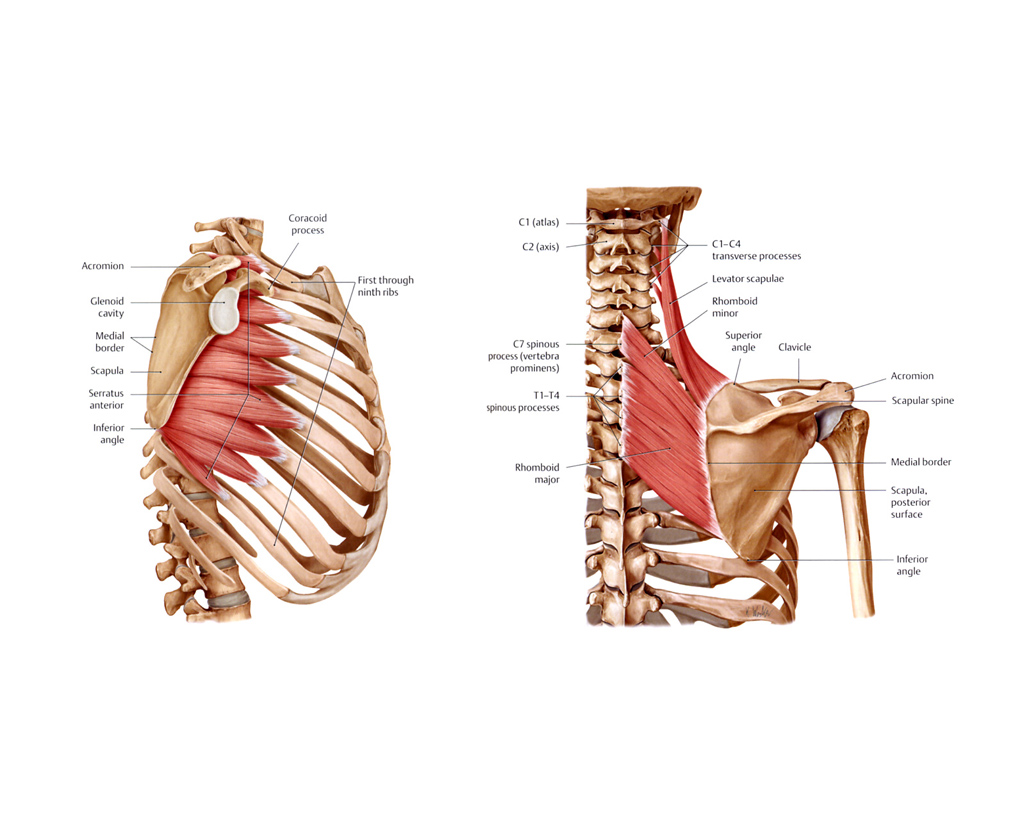
Muscles that comprise the Rotator Cuff
  • The Glenohumeral (shoulder ball and socket) joint has muscles (rotator cuff) that attach it to the scapula
  • Scapula is a "floating bone" which is anchored to the rib cage by the anterior serratus  
  • The scapula to the spine by the rhomboids and the levator scapulae.
  • The spine is stabilized by the core muscles  
If any muscle along that chain is weak, the unit will only function as well as the weakest muscle can tolerate. In other words, the chain is only as strong as its weakest link.
Fortunately, there are many core exercises that can be used to strengthen all of the muscles together as a unit, thereby increasing the ability of the ENTIRE chain.

So here are 3 exercises that you can do to train the kinetic chain of an overhead thrower.

1. Side planks - Side planks train the muscles of the Glenohumeral joint, scapulothoracic joint as well as the lumbar stabilizers in the frontal (lateral) plane. This is one of the best exercises for improving core stability and is a necessity for ANY overhead throwing athlete.
 
2. Supine opposites/ Deadbug - the deadbug trains the muscles of each side of the body to operate independently. This trains the body to prevent rotation and stabilize the core - a REAL strength and control exercise 


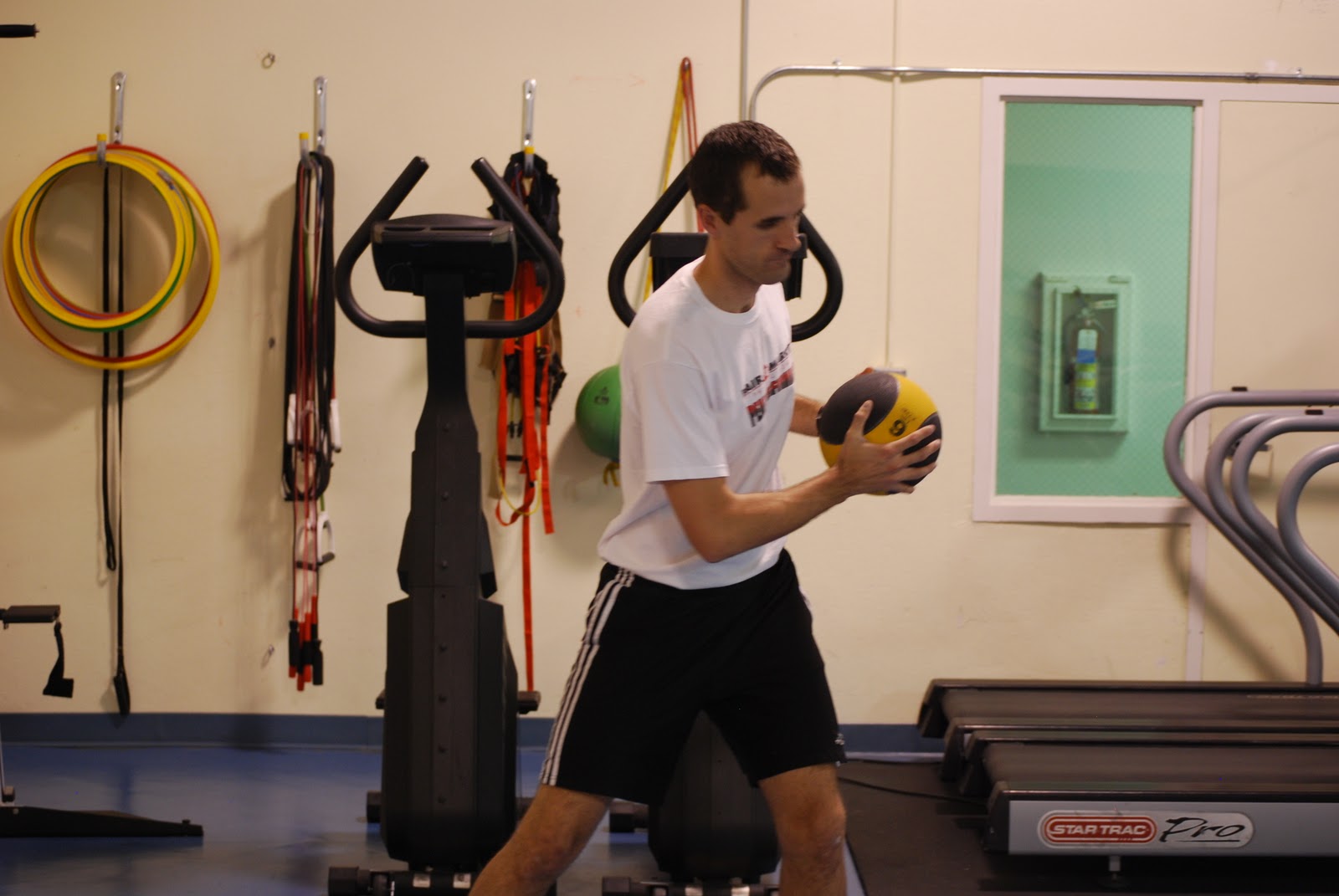
Med Ball Shakers

3. Med ball shakers - Using a medicine ball, take an athletic stance and quickly shake the ball back and forth for 6-10 seconds. You'll know if you are doing it correctly because your abdominals will be on fire. If you're arms are burning then there is a good chance that you are having issues using your abs to initiate motion and instead are using your arms.

These arejust three of the exercises that we have used in our the baseball players we train for speed, agility and quickness here at Pair & Marotta Peak Performance!

To learn more about core training for Baseball and Softball using just your body weight and a bat, get registered for our "On-Field Core Training for Baseball/Softball" workshop on Saturday January 22 from 10am-noon. You'll leave with a TON of valuable tools that you can use on field with your team!!
Email aaron@pairmarotta.com for more information!

Thursday, October 28, 2010

The magic bullet for speed and agility is....

I recently read an article by one of my favorite strength coaches, Mike Boyle. I have a handful of his instructional DVD's as well as his most recent book "Advances in Functional Training." 

In his article he stated that so many people are looking for the "magic bullet" to speed and agility. Some people think it's the speed ladder. I mean, it isn't called a speed ladder for nothing right?

While the speed ladder does improve coordination and rhythm, it isn't the magic bullet.

Still other coaches thought that the key to speed and agility was the resistance parachute. So these became all the rage. And for good reason. They provide resistance, but not so much resistance that it changes an athletes running mechanics. But alas, the speed chute was used, but players did not become more agile.

So what is the "magic bullet"? The magic bullet is a quality training program that addresses:
  • Ankle, hip and thoracic spine mobility
  • Knee, low back and shoulder stability
  • teaches basic movement patterns such as a lunge, squat, push, pull, and hip rotation
  • Corrects muscle tightness and poor posture
  • Teaches the body to move quickly with minimal self-imposed resistance
Basically training athletes is like working on a car - adding a new engine won't give the car top performance if the suspension is horrible. Likewise a new suspension won't do as much as if the tires were improved. And last but not least, if the driver is not competent, then the car won't drive well no matter what you do.
Developing a quality athlete requires development of all skills, not JUST those used in a specific sport. Think about the last post I wrote about the multi-sport athlete. The multi-sport athlete is a rare specimen these days. Yet, they are often the most coveted athletes by scouts, coaches, colleges and pro teams.
The magic bullet is activity. Let your kids play and play a lot. Oh yeah, and let them play with minimal interference from coaches, parents and a ton of rules. Let them make their own rules and settle their own conflicts on the field. They need it to grow not only physically, but also emotionally and psychologically.

The magic bullet is really a toolbox filled with tools that is used to tune the car. When you add tools to the box, you become much more valuable and usable. 

In addition, when a player has a toolbox full of tools, they can attack any problem and be successful. Isn't that what you want for your kids?

Monday, August 30, 2010

I don't teach athletes how to jump...

It never fails that people want to know how much their athletes vertical leap will improve IF they enroll our training programs. If they don't like the answer they get they usually brush me off and head off looking for somebody that will give them the answer they are looking for.


So in reality many parents are simply asking a question of my ability. But a parent or coaches concerns about my ability should not lie in whether I can improve their vertical jump, but whether I can keep them injury proof. Here is why.


I WON'T TEACH YOUR ATHLETE TO JUMP, UNTIL THEY KNOW HOW TO LAND.


If a skydiver can't land, should he really be jumping out of a plane?


The majority of non-contact knee and ankle injuries come from improper foot placement during deceleration/landing or from inadequate joint stabilization during landing. Either way, the problem is during the landing.


I have been researching hamstring strains in sprinters and even in those cases, the hamstring is never injured on the pull through, but rather is injured immediately after the heel strike following the flight phase.


Soccer Player Cutting
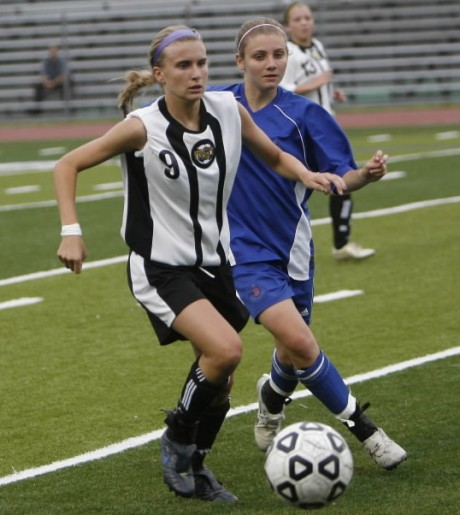
So if you want to keep your players safe, teach them how to land. Teach them how to decelerate and teach them that having a high vertical leap, possessing a fast shuttle run and having a lightning quick T-test is only a result of proper deceleration training - the same type of quality training that we focus on in our "Bullet Proof Your Knees" Soccer Camp.


We are starting tomorrow and still have a handful of spaces available. The camp meets on Tues/Thurs from 4-5pm for 6 weeks. For only a $120 investment, your athlete will come away more agile, quicker, and most importantly, with a much lower risk of non-contact injury!


For more information send me an email at aaron@pairmarotta.com.

Monday, August 23, 2010

Are we even doing this correctly?

How many youth coaches are training their players to be slower? 

How many want their kids to move like a sloth and then get absolutely juked out of their shoes as the opposing player runs right by them?

How many infielders want to have the range of a step and a fall? 

Certainly there are not any coaches who want their players to be SLOW. But many are unintentionally making their players slower!


You see the nervous system is a very plastic thing. Plastic is a fancy word. it's true. When something is plastic, it changes to take on the characteristics of its mold and then holds onto those traits.


So when the human neuromuscular system is considered plastic, it will take on the traits of whatever stress is placed on it. Most of us want our players to be fast. In order to do this we need to make sure that their movements are fast each and every time. Otherwise the neuromuscular system will begin to operate in the speed range of whatever speed is most often used.


Right now many of you are envisioning telling your players to constantly move fast. You're envisioning them moving faster than lightning and envisioning them doing it for the entire 90 minutes of your practice.


But there is a problem.


The human body cannot move as fast as possible for very long. And by very long I mean any longer than about :10. After that fatigue begins to set in. How do we combat that? By giving more than enough rest. So many coaches are of the mindset that kids are not making progress unless they are about ready to fall over from exhaustion.


If you want them to be great at running slowly for 90 minutes straight, then sure. keep them going. But you aren't going to get very good work out of them. Think about it. The team is running for "conditioning." They aren't moving very fast and they are doing hundreds, if not thousands of repetitions at less than maximal contraction speed. 


What exactly is this TRAINING them to do? Because that is what is being done. Just like we train horses how to run, jump and canter, we train kids bodies to move at a certain speed. Whether we intend to or not, it happens. So with every step, they are getting slower and slower.


To make athletes faster, you MUST present a stimulus that requires them to move as fast as possible (while still in control). Then give them plenty of rest so they can come back and give you another rep with 110%. 


This is something that we have developed over the past 5 years through research and through practical experience. We practice this in our FAST Forward and Movement First Programs. Don't believe me? Come try either class out for a week on me.


We start next week, August 30! Do not wait to sign up, we will only be taking 8 athletes for each of these groups. For more information, visit our website www.pairmarotta.com/fitness.

Send me an email at Aaron@pairmarotta.com and we will be sure to get you setup for a free week of workouts!

Thursday, January 22, 2009

The In-Season Dilemma


The baseball season is already here!!


Local high schools are getting ready to start practicing and many youth leagues are already on the diamond!! They practice and play, play and practice. They practice hitting, bunting, fielding, throwing, leading off, pickoff moves and learn the coaches signs
from third base.
But lets take a step back. What is it that allows kids to play baseball? More generally, what is it that baseball requires to be good at? Movement. And that is what we at Pair & Marotta Sport Performance specialize in: Teaching Movement.

Movement is what allows baseball and softball players to swing a bat regarless of whether they hit the ball. But rarely do kids focus on just movement. They would rather make contact with an ugly swing than strikeout with a powerful swing. Don't believe me? Watch a youth athlete in the on-deck circle and then watch them at the plate. When there is no ball coming at them, their swing is simply a flop of the bat. Watch them when they step out of the box between pitches. These are the times to be focusing on a good swing.

So how does Pair & Marotta Sports Performance fix that? How do we work on the quality of the swing without the stress of them worrying about hitting a ball, but rather focusing on a good quality swing? We teach hip rotation and extension to drive the swing. We teach athletes how to put a stretch in the muscle, then to unleash it by getting a good solid contraction out of the muscle. We start in a squat to load the hips, then explode out and release the elastic energy we just created.

This is just one example of the types of exercises each athlete will be performing while at Pair & Marotta Sport Performance.

Many people think when the season begins, the strength program must stop. This could not be further from the truth. Strength training during the season actually improves the sport skills that are being taught while at practice. Watch as the athleticism of a player who trains during the season improves, while that of others is stagnant or declining.

Pair & Marotta Sports Performance In-Season Program starts February 2nd. If you're in Bakersfield and would like to be a part of it, email me at aaron@pairmarotta.com or call 661-912-9991. We are capping each group at 10 players, so don't wait too long!!

Wednesday, October 22, 2008

Picking Up the Pieces and Looking to 2009

With the World Series starting tonight, the two best teams in Major League Baseball will square off over the next week. What will be left is one team riding a float down main street of their respective city, and the other picking up the pieces of a season that couldn't be finished.

And just like you need to be doing, they are soon going to start preparing for the 2009 season. They will start getting stronger, faster, quicker and more powerful. Because they want to last through the 2009 post-season.

A strength and conditioning program isn't just for the elite. It is for those who desire to be elite. It is for those who want nothing less than the most out of their body, and it is for those who don't consider the season a success unless they win their last game.

Pair & Marotta Sports Performance has the program you and your team needs. Our facility is specifically designed and set up to accommodate teams of over 25 athletes. If you want there to be no question in who the best team on the field is, you will find your self in here.

In order to be the best, you've got to train with purpose and with intensity. Or as we like to say, you need to Train Like You Mean It.